
El Niño and Coral Reefs: Marine Heat, Bleaching and NOAA's Current Alerts
Updated: October 5, 2026 · 5 min read · Live dashboard
Coral bleaching is a heat problem, and El Niño moves heat around the tropical ocean. When a reef's water stays above its normal summer maximum for weeks, corals expel the algae that live in their tissue and feed them, and turn white. A bleached coral is not dead: if the heat eases, it can recover. If the heat lasts, it can die.
That is why reef scientists watch the Pacific as closely as forecasters do. Every global coral bleaching event NOAA has documented, in 1998, 2010, 2014–2017 and from 2023, overlapped an El Niño. With the 2026–27 event heading for a peak around the turn of the year, the box below shows what NOAA Coral Reef Watch reports for the Great Barrier Reef and the Caribbean as of its latest daily data.
Coral bleaching heat stress now — NOAA Coral Reef Watch
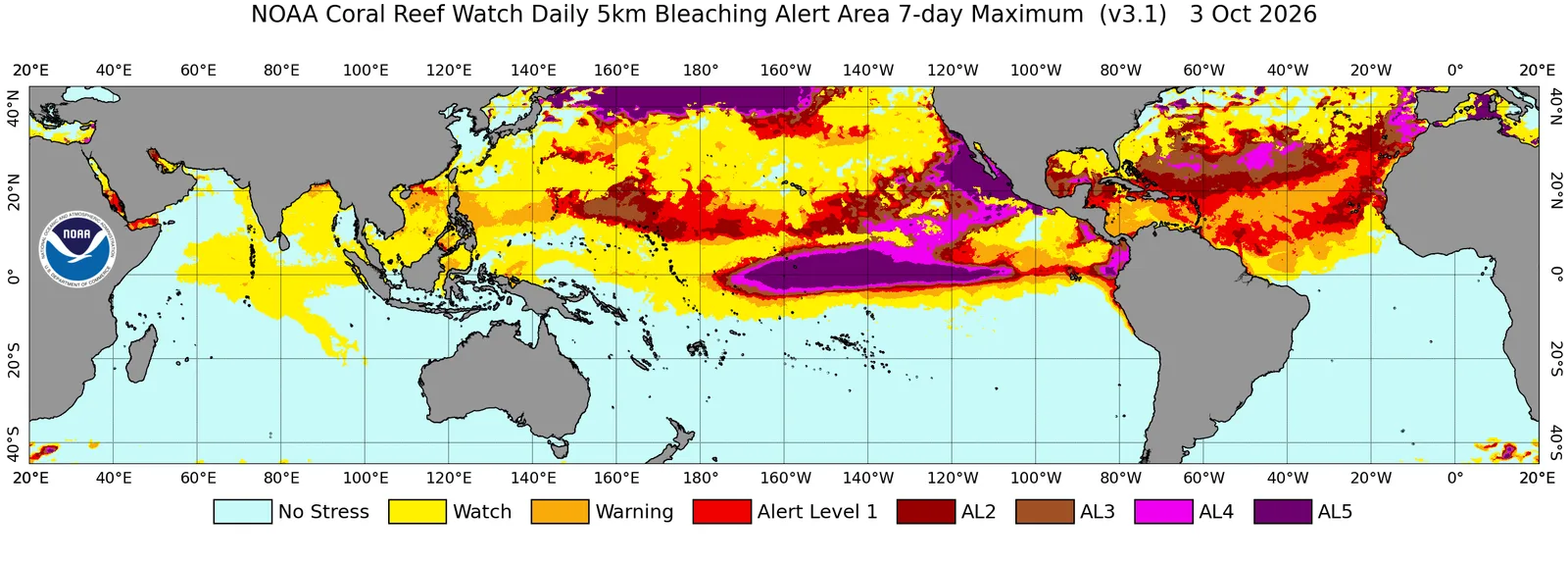
Scroll sideways across the map.
Great Barrier Reef CRW data for October 3, 2026
All 4 stations at No Stress.
- Far Northern GBRNo Stress0.0 DHW
- Northern GBRNo Stress0.0 DHW
- Central GBRNo Stress0.0 DHW
- Southern GBRNo Stress0.0 DHW
Caribbean CRW data for October 3, 2026
20 of 25 stations at Alert Level 1 or higher; highest: Alert Level 5 (Southwestern Cuba, 19.7 DHW).
- Southwestern CubaAlert Level 519.7 DHW
- Colombia AtlanticAlert Level 417.5 DHW
- Northwestern CubaAlert Level 416.6 DHW
- Quintana Roo, MexicoAlert Level 416.3 DHW
- Southern HispaniolaAlert Level 314.7 DHW
- Southeastern CubaAlert Level 314.2 DHW
- Northeastern CubaAlert Level 313.0 DHW
- BelizeAlert Level 312.8 DHW
- Cayman IslandsAlert Level 211.9 DHW
- Trinidad and TobagoAlert Level 211.0 DHW
- Leeward Caribbean IslandsAlert Level 28.1 DHW
- Northern HispaniolaAlert Level 28.1 DHW
- Virgin IslandsAlert Level 17.4 DHW
- JamaicaAlert Level 17.1 DHW
- Panama Atlantic EastAlert Level 16.9 DHW
- Puerto RicoAlert Level 16.8 DHW
- HondurasAlert Level 16.4 DHW
- NicaraguaAlert Level 15.6 DHW
- Windward Caribbean IslandsAlert Level 15.0 DHW
- Nearshore VenezuelaAlert Level 14.0 DHW
- La Guajira, ColombiaBleaching Warning2.6 DHW
- Panama Atlantic WestBleaching Warning2.5 DHW
- Costa Rica AtlanticBleaching Warning1.8 DHW
- Offshore VenezuelaBleaching Watch0.3 DHW
- Aruba, Curacao, and BonaireBleaching Watch0.0 DHW
Level = the highest daily Bleaching Alert Area level of the 7 days ending on the date shown; DHW = Degree Heating Weeks (°C-weeks) on that date, so a level can sit above what that day's DHW alone would give. CRW's virtual-station files stop at “Alert Level 2”; as CRW's station pages instruct, Levels 3–5 are worked out from the same files' daily HotSpot and DHW values using CRW's alert-level table. Downloaded October 5, 2026. Source: NOAA Coral Reef Watch, Version 3.1 Daily 5km Regional Virtual Stations.
How heat becomes bleaching
NOAA Coral Reef Watch (CRW) measures heat stress against each reef's own climate. Every reef has a maximum monthly mean: the average temperature of its warmest month. Corals tolerate that. CRW calls any excess above it a HotSpot, and it adds up the excesses of at least 1°C over a rolling 12 weeks. The total, in °C-weeks, is the Degree Heating Week, or DHW.
The alert levels are steps on that scale. At 4 DHW CRW issues Alert Level 1, its risk of reef-wide bleaching. At 8 it is Alert Level 2, which adds a risk of death for heat-sensitive corals. On December 15, 2023 CRW added three further steps at 12, 16 and 20 DHW, describing risks from multi-species mortality up to the loss of more than 80% of corals. CRW gave its reason: extreme heat stress in 2023, especially in the eastern tropical Pacific and the Greater Caribbean, confirmed by in-water observations.
Two things the levels are not. They are not a count of dead coral: they say how much heat a reef has absorbed, and divers and aerial surveys confirm what it did. And they are not a forecast. A level is the highest of the past seven days, and it falls back once the heat breaks.
What El Niño changes
During El Niño the warm pool that normally sits in the western Pacific spreads east, the trade winds weaken, and the pattern of ocean heat across the tropics shifts with them. The weekly Niño 3.4 reading on the dashboard tracks the centre of that change. Reefs feel it at different times depending on where they sit, which is the most useful thing to know about El Niño and coral.
CRW's review of the 1997–98 El Niño, which it notes has been argued to be the largest on record at the time, traced the sequence. Heat stress reached reefs in the central and eastern Pacific soon after the event began in mid-1997. It moved to the Great Barrier Reef and the South Pacific islands in February to April 1998, to the Indian Ocean from March to June, and to the Caribbean from July, peaking there in October. The La Niña that followed then brought heat stress to the north-western Pacific. CRW cites an estimate that more than 15% of the world's coral reefs were effectively lost over 1997–1999.
The timing is the point. A reef is most exposed in its own hottest season, and El Niño adds heat on top of that. For the Great Barrier Reef that is the Southern Hemisphere summer, a few months after the Pacific peak. For the Caribbean, CRW, citing a 2009 study by Eakin and colleagues, notes that bleaching-level warmth is most commonly seen in the year after an El Niño begins. That also means a hot Caribbean autumn in the year an event starts is not, on its own, El Niño's fingerprint.
Every El Niño and La Niña since 1950
Oceanic Niño Index (3-month running mean of Niño 3.4 anomalies); dashed lines mark the ±0.5°C thresholds
The chart above marks the El Niño years. Set CRW's global events against it: 1998 after the 1997–98 event, 2010 after 2009–10, the long 2014–2017 episode around the record 2015–16 event, and the fourth event from 2023. CRW reports that from January 1, 2023 to September 30, 2025 bleaching-level heat stress reached about 84.4% of the world's reef area, against 68.2% in 2014–2017, and wrote in June 2026 that the fourth event likely ended in 2025.
The Great Barrier Reef
The reef stretches more than 2,000 km along Queensland, and CRW's virtual stations split it into four sections from the far north to the south, each with its own daily series. In 1998, the 1997–98 El Niño brought bleaching-level heat to the reef in February and March. The Australian impacts guide covers the drier seasons and hotter summers the same events tend to bring on land.
For the central reef, CRW's climate record puts the warmest month in February. For 2026–27 the same history points to one window: the Southern Hemisphere summer of early 2027, after the Pacific peak. That is when the reef's readings in the box above will matter most; readings from the southern winter and spring describe the reef outside its hot season.
The Caribbean
The Caribbean is the other side of the same story. Its reefs sit far from the Pacific, and El Niño's influence reaches them later. In 1998 heat stress there built from July and peaked in October, more than a year after the Pacific event began.
The Caribbean also bleaches without El Niño's help. NOAA's Ocean Service notes that the United States lost half of its Caribbean coral reefs in a single year to the 2005 bleaching event. In CRW's climate record for Jamaica the water is warmest in September, so Caribbean levels carry the most weight from late summer into autumn in any year. By CRW's history, the season to watch for this event's signal is late 2027.
What the numbers will not tell you
Satellite heat stress is a strong warning, not a verdict. Corals in the same reef differ in how much heat they tolerate; a cloudy week or a passing storm can cool the water in a few days; and recovery after bleaching can take years even when the coral survives. CRW publishes what the ocean surface did. Field surveys by reef agencies in each region report what happened to the coral.
What to watch
- The Great Barrier Reef's four sections from January to April 2027, the reef's summer after the Pacific peak.
- How long any Caribbean station stays at Alert Level 2 or higher, not just the level it reaches.
- The live map for where the warm water sits in the tropical Pacific now.
- CRW's heat-stress updates, which track how much of the world's reef area has seen bleaching-level heat.
Keep reading
El Niño in Australia: Drought, Bushfire Risk and the 2026–27 Season
Dry east, primed fuels, a wheat belt on edge — Australia faces the sharpest downside of a strong El Niño winter and spring.
The 1997–98 El Niño: The Benchmark Monster
The 'El Niño of the century' peaked at +2.4°C, killed thousands through floods and fires, and turned ENSO into a household phrase.
The 2015–16 El Niño: Strongest on Record, Full of Surprises
A record +2.6°C peak, a global coral catastrophe — and a famous Southern California rain no-show that rewrote how forecasters talk about odds.
El Niño 2026: Tracking a Potential Super El Niño in Real Time
Declared in June, already strong by July, and forecast to peak in the Northern Hemisphere winter — the definitive guide to the 2026–27 event and its super-El-Niño odds.
Frequently asked questions
- Does El Niño cause coral bleaching?
- El Niño does not bleach coral directly; heat does. But El Niño reorganizes where the tropical ocean is warmest, and NOAA Coral Reef Watch's review of 1997–99 traced reef heat stress moving from the eastern Pacific to the Great Barrier Reef, the Indian Ocean and finally the Caribbean as that event ran its course. Each of the four global bleaching events NOAA has documented, in 1998, 2010, 2014–2017 and from 2023, overlapped an El Niño.
- What do the Coral Reef Watch alert levels mean?
- They measure accumulated heat, not observed bleaching. Degree Heating Weeks add up how far and how long water has stayed at least 1°C above a reef's usual warmest month over the past 12 weeks. NOAA puts Alert Level 1 at 4 DHW, Alert Level 2 at 8, and Levels 3, 4 and 5 at 12, 16 and 20. NOAA describes the risk rising from reef-wide bleaching to near-complete mortality across that range. Divers and surveys confirm what actually happened.
- When is the Great Barrier Reef most at risk in an El Niño?
- In the Southern Hemisphere summer. In 1998 NOAA saw bleaching-level heat on the reef in February and March, months after the Pacific event peaked. The 2026–27 event is forecast to peak around the turn of the year, so by that history the reef's own summer, early 2027, is when its heat-stress readings matter most. That is a historical pattern, not a forecast of bleaching.
More answers on the full FAQ page.